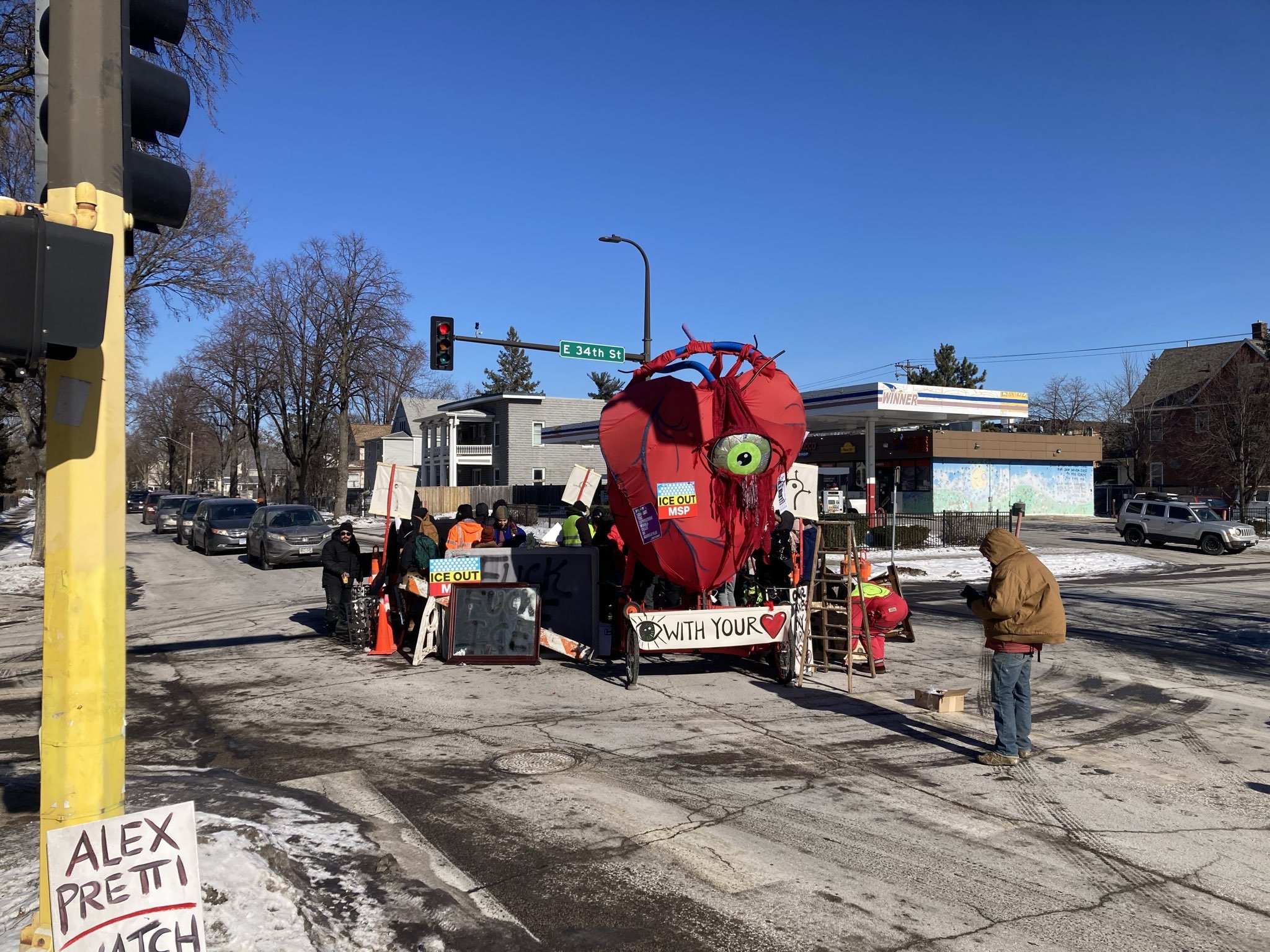
The Twin Cities has been under siege by federal agents since December, 2025. The invasion has led to the emergence of a generalized popular uprising as well as the deaths of two people at the hands of ICE--Renee Good and Alex Pretti--and the shooting of a third who survived. As we go to publication, ICE agents are continuing to kidnap, shoot, and harass Twin Cities residents under the legal pretense of Operation Metro Surge. People have been pouring in from across the country to aid the on-the-ground resistance. L&F interviewed a life-long resident of Minneapolis about their experiences resisting ICE in the Twin Cities. In specific, the discussion focused on the innovation of filter blockades as another tool to combat ICE in metropolitan centers.
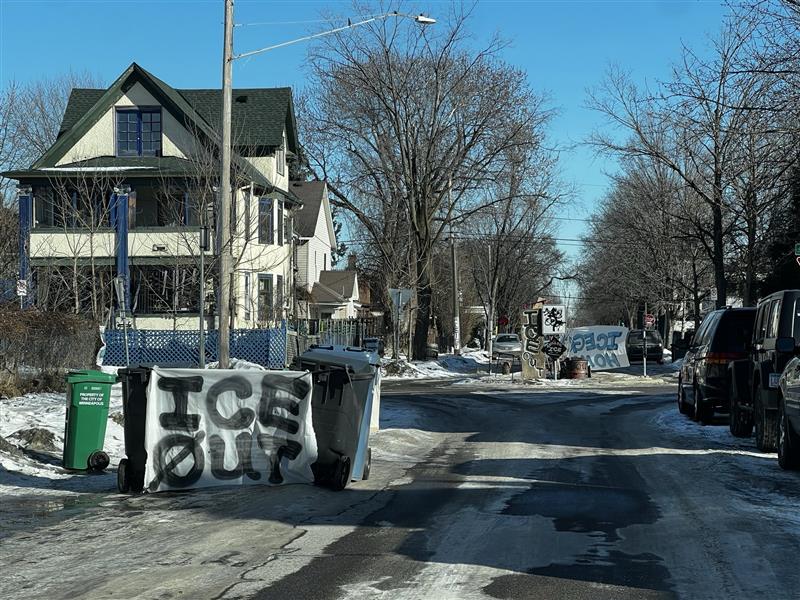
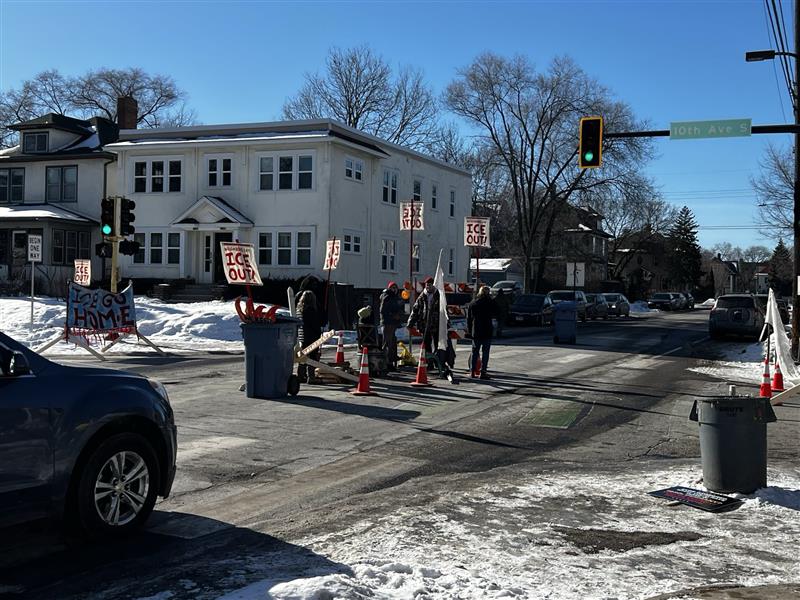
Filter blockades are not a new tactic--they were used in the Yellow Vests movement in France and the Oaxacan uprising in 2006. Blockades as a more general strategy date back as far as the Paris commune. The logic behind a filter blockade is simple: turn a four-way intersection controlled by traffic lights into a roundabout with blockade material in the center of the intersection. Blockaders then fill a variety of roles in order to identify and confront ICE agents. Roles of filter blockades in general include: scanners (plate checkers), senders (traffic directors), orienters (task and role point person), reinforcements (people holding down the center blockade), and comms (communicating with Rapid Response groups and other filter blockades). We interviewed a life-long resident of Minneapolis named Casey about filter blockades and the uprising against ICE in the Twin Cities.
Living & Fighting: Tactics have varied in the different waves of protests against ICE in the Twin Cities. Particularly in how people resisting the occupation have utilized different tactics: from Rapid Response Networks, to noise demos, to mass mobilizations and to blockades. Do you think the shifting of tactics in real time, or the "be like water" approach, has been advantageous or not to organizing against ICE in the Twin Cities? From an outside perspective it seems very adaptive, calculated and intentional. Also, give Tom Homan's arrival in Minneapolis, can you speak to the ways the Minneapolis Police Department (MPD) are working with ICE agents in the Twin Cities?
Casey: The tactics used to resist ICE have had to shift significantly over the past month or more to keep up with the shifting tactics of ICE themselves. They essentially stopped conducting large-scale raids as we are maybe used to seeing in the past from immigration agents. Instead they are traveling in smaller groups that are able to be more mobile and trying to isolate their targets for quick abductions. The speed and flexibility of this strategy forced people to figure out new forms of resistance to match. So you have the rapid responders who are able to track and follow ICE across the metro, and you also have the noise demos that try to take advantage of some of the static targets available—where the agents are literally sleeping. The filter blockades are a newer contribution to the rapid response networking of tracking ICE and interfering with their ability to move freely throughout the city.
Tom Homan's arrival has accompanied a shift in discourse between the local and federal governments. They have put the possibility of withdrawal on the table, but it comes with a compromise that involves—among other things—closer cooperation from MPD. At the time of writing, it's not clear how this in particular will shake out. Otherwise, MPD has primarily only been involved for crowd control so far.
L&F: Last weekend filter blockades sprang up across south Minneapolis, to my understanding, predominately in the Powderhorn Park neighborhood. Can you give us a little context as a brief history of this street tactic and how folks in Minneapolis come across this as a tool for community self defense?
Casey: As I mentioned above, the filter blockades offer a method of directly impeding ICE's ability to move freely through the city. It is meant to be used in conjunction with other forms of rapid response, like commuters who follow them to their targets, and is most effective when information is being shared amongst the different roles.
The first ones appeared mid-week on just small, neighborhood streets with little traffic already. Then over the weekend of January 31st to February 1st, multiple were formed along somewhat busier streets—also in Powderhorn. I don't think I could give you a full history, but they certainly harken back to the Oaxaca commune of 2006, or more recently the gilets jaunes [Yellow Vests] in France.
L&F: It is our understanding that on last Sunday, February 1, there were four to five different filter blockades happening simultaneously in south Minneapolis. Is this correct and if so, what makes the strategy behind filter blockades as a tactic more effective if more community members set up their own blockades?
Casey: Yes, I believe that is correct. I personally saw four filter blockades in a small area, two along Cedar Ave which is a somewhat busier street, and then two more in parallel on a smaller street. The two smaller ones were actually taking place in roundabouts that were already built into the road, but they were using regardless to keep track of passing vehicles.
The more people that create filter blockades simultaneously, the better. If there's just one or two, it could be easy for ICE to route around (although they haven't been able to do so very well already) but if there were twenty or a hundred across the city, all of a sudden it becomes incredibly difficult for them to get where they are trying to go.
L&F: Mainstream media has claimed that residents were being detained and having their IDs checked at the filter blockades, as if random residents were being detained out of pure suspicion. Is this true? The only case I could come across online was a situation where a journalist was asked to stop filming during a confrontation with an actual ICE vehicle near a blockade.
Casey: This is a wild exaggeration, as I'm sure you could guess. At one point on Sunday, rapid responders noted an increase of ICE vehicles in the general area, and so one of the blockades decided that they would close the road to cars that looked suspicious to confirm they weren't ICE before allowing them to pass. This didn't involve checking anyone's ID, but checking their license plate against a database of confirmed ICE license plates. The process is far from perfect, as there are human beings making a judgement call about what vehicles count as "suspicious," and relies on others to have correctly assessed a license plate number as ICE in the database. But even of the few drivers I saw stopped—and only for maybe thirty seconds—they were still supportive and understanding of why it was happening. I don't believe they were doing this for more than an hour or two anyway.
L&F: The question of legality comes up quickly when talking about filter blockades. This seems ridiculous considering the Fed's complete rejection of the law and procedure, and when we account for the fact that the Feds have now shot and killed 2 rapid responders and shot and injured another resident in Minneapolis just in the last month. Some politicians and police unions in the Twin Cities have come out and condemned the use of filter blockades as a tactic. With the total refusal of both state and federal agencies to protect the people of the Twin Cities, how has the duality of legality and illegality manifested in this tense historical moment?
Casey: As you said, the law has been suspended by the federal occupiers. I don't think the question of legality means much anymore. I don't remember hearing anyone who joined the blockades question if they were breaking the law or not. People are looking for material, practical ways they can support and defend their friends and neighbors, whatever that looks like.
Plus, due to the MPD's ambiguous position in the situation, they were happy to avoid interfering with the blockades for the entire weekend. In one instance, an officer even expressed support for them. We know these are empty words, but it's illustrative of the bind they are in, one we hope to take advantage of.
L&F: There have been multiple calls for filter blockades to pop up this Saturday in the Twin Cities. Can you tell us a little about the call to action? Does this signal a shift in how resistors are combating ICE in their own areas? Whether the Twin Cities or nationally?
Casey: It's funny because some friends I have talked to about it told me their neighbors or their roommates were already discussing how to set up a filter blockade of their own before the call for Saturday was even published. It's caught on very naturally as a tactic that responds adequately to the situation. That said, it remains to be seen just how many will be set up on Saturday. But if it's successful, it would definitely create a new dynamic in the balance of forces, with people staking a claim in their territory against the occupation in a new way.